MRWC
Millers River
Watershed Council, Inc.

100 Main Street, Athol, MA 01331
ph 978-248-9491

Email

An associate of the
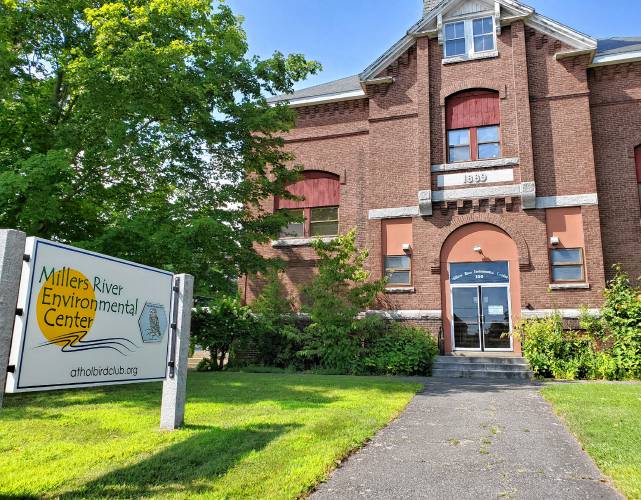
Millers River Environmental Center

River Quote
“Rivers have what man most respects and longs for in his own life and thought – a capacity for renewal and replenishment, continual energy, creativity and cleansing.” – John M. Kauffman

Upcoming Events

News & Reports
  and NIA Database

Membership Information

DONATE
Support MRWC

Our Current Projects
Volunteer opportunities.
How to protect your favorite stretch of river.

Resources and Links
*

Cass Meadow Restoration
  Photos

WATER TRAIL - UPDATES

Millers River Water Trail Team

Otter River Water Trail Team

Notice:

Saturday July 23rd - 10 am
MILLERS RIVER BLUE TRAIL -- INAUGURAL PADDLE & CEREMONY (ATHOL)

Join us to celebrate the new Millers River Blue Trail and test out the new TRAIL GUIDE!
For details click on the "WATER TRAIL UPDATES - MILLERS" page in the blue box to the left.

Saturday July 30th - 1 pm
OTTER RIVER BLUE TRAIL -- DISCOVERY DAY PADDLE (TEMPLETON)

Join us to explore the Otter River Blue Trail.
For details click on the "WATER TRAIL UPDATES - OTTERS" page in the blue box to the left.

*

NEW SUMMER 2011 BACTERIAL WATER SAMPLING RESULTS:

To check that our river waters are safe for recreational activity, MRWC is conducting bi-weekly sampling of 5 locations on the Millers River in Athol and Orange and 4 locations on the Otter River in Templeton and Gardner.

So far, all results are GOOD!

To REVIEW RESULTS, click on the following link: 2011 MILLERS R. AND OTTER R. BACTERIAL SAMPLING RESULTS

*

MILLERS-OTTER BLUE TRAILS PROJECT

The Millers and Otter River Blue Trails are being developed as community-based projects to raise the profile of our local rivers, highlight their recreational, scenic, natural and historic qualities, make them more popular for use and appreciation by local residents and tourists, and strengthen our communities.
* The Millers River Blue Trail covers the River Rat Race segment of the river between Athol and Orange.
* The Otter River Blue Trail covers The Otter River along its entire length from Hubbardston, Templeton, Gardner and ending where it joins the Millers River in Winchendon.
Residents, businesses and community groups from these towns are invited to participate in making this project a long-term success for the rivers and our communities.

Contact Blue Trails outreach coordinator Keith Davies at 978-248-9491 or email watershed_americorps@mountgrace.org.

Blue Trails Events Calendar:Check the MRWC or ABNC website calendar for listings -- Spring is volunteer field work time!.

"Adopt-A-Sample": Help support water monitoring for bacteria on the Millers and Otter Rivers this summer. A $25 donation covers the cost of a laboratory analysis for one sample. Our goal is to sample up to 20 sites at least five times, so we're aiming for $2,500 to process 100 samples. Your support can make a big difference to ensure our river water is healthy for recreational contact.
You can pay by PayPal here on the MRWC website, or send a check payable to MRWC at 100 Main Street, Athol, MA 01331. Be sure to mark "adopt-a-sample" on the check's memo line.
Sampling results will be posted on the MRWC website in the fall.

Millers River Blue Trail Logo Design Contest: Deadline for submissions is June 1; winning logo will be presented at July 23rd trail Day event. Contact Keith Davies to request a copy of the contest guidelines, at 978-248-9491 or email watershed_americorps@mountgrace.org.

Millers River Blue Trail Jan. 6, 2011 Kick-Off meeting Report

CALL TO ACTION

The Millers River Blue Trail inaugural meeting drew a good crowd of just over two dozen people. AOTV filmed the presentation and discussion. People of all ages, civic leaders, paddlers and hikers, nature lovers, history buffs, all turned out to learn about and begin to help with this special long-term community project. As highlighted at the meeting, the Blue Trail will serve as a dedicated stretch of river between the two anchor towns of Athol and Orange where the river itself will serve as the trail or path. The two town parks at either end will serve as start/end points. The trail offers a variety of benefits to people and the region, including recreation, community pride and education, conservation and eco-tourism potential. Stewardship activities will also be a key component for the trail's long term integrity, such as river clean ups, water quality monitoring, and maintenance on any connecting trails. The presentation noted a need to secure additional open space along the river corridor to preserve and enhance the character of the trail. Though the trail in this segment of the river is primarily the river, proper and careful open space additions could add footpath access in places where people could discover this special resource. MRWC has established a regular monthly Trail Team meeting schedule (SECOND Monday - 7pm) throughout the development stage of the trail. These gatherings will be held in the evenings, but also a day time open house at MREC will be offered. The goal is to begin field surveys in the spring and use the information to draft a trail map. The surveys will look to highlight and document both natural and historical information/sites. The winter work will identify possible places to highlight on a map, and the field work will do the ground-truthing and GPS locating of the points of interest. Spring and summer field work will offer insights into any differences due to the seasons. The Jan. 6th meeting was an introduction to this special opportunity. We now need to put our heads together, research the natural and historical features of the river, plan events, collect information, then put it all together to give life to this trail. Our next evening meeting is MONDAY FEB 14 @ 7PM @ MREC, 100 Main St, Athol, MA 01331. A day-time open house will be TUESDAY FEB 15 @ 10AM @ MREC. Please plan to attend or forward any specific information that you can. Thank you. Please drop me a note to confirm you will be coming.

Keith Davies,
978-248-9491

Millers River Blue Trail Project Development Check List For the Feb 14 meeting, bring what you can to identify:

Special natural features
Historical places
Access needs
Spring weekend dates to start field efforts
Special event ideas
Open space or stop points along the trail (what permissions would we need?)

We will start a resource inventory to use for when we get out on the water to GPS mark all key Trail locations.


*

FREE ENVIROSCAPE PRESENTATIONS

The MRWC offers free 3-D Enviroscape Watershed/Non-Point Source Pollution presentations to audiences of all ages. Presentations can be tailored to address specific concerns, including groundwater. If you wish to schedule a presentation for your school or community group, please contact the Council. A typical presentation runs approximately 50-60 minutes.

Message from the President:
Greetings, neighbor. We have updated our Projects page. Find out about our water monitoring, educational and recreational activities. Get involved! We are more focused on collaborating with local municipalities and on obtaining high-quality water monitoring data. We’re also focusing more on the Otter River subwatershed, through our Otter River Initiative. We hope you find our ongoing efforts worthy of your support and we welcome your feedback.. Please make a donation today—We COUNT ON YOU!
For the Watershed ­ David Brule, Erving

Welcome

This site is maintained to provide you with information about the Council and the Millers River it protects.

The MWRC is a nonprofit organization dedicated to educating, advocating, and organizing for the protection of the watershed's natural resources. The Council's primary concern is for the restoration and maintenance of clean water through the wise use and proper management of water and related natural resources in the Millers River Watershed.

Our Council is made up of local citizens working to protect the Millers River water resources. It is part of a larger cooperative effort of agencies, both federal and state, and other conservation-minded organizations. Together we make decisions on water resource priority issues and then work collectively to resolve those issues.

An associate of the
Millers River Environmental Center

download
Millers River Action Plan
Citizens Handbook for Watershed Advocacy
PDF file 10MB


Millers River, (c) Paul Rezendes
Photo used by permission

The Watershed: in Brief

• Source: Southern New Hampshire and North Central Massachusetts
• Total drainage area: 392 square miles, with 320 square miles in Massachusetts.
• Covers all or parts of 17 towns in north-central Massachusetts:
Ashburnham, Athol, Erving, Gardner, Hubbardston, Montague (Turners Falls), New Salem, Northfield, Orange, Petersham, Phillipston, Royalston, Templeton, Warwick, Wendell, Westminster, and Winchendon.
The Watershed also includes parts of six New Hampshire towns: Fitzwilliam, Jaffrey, New Ipswich, Rindge, Richmond, and Troy.

Council History

The Millers River Watershed Council was formed in the middle of the last century after the color and smell of the Millers River varied on a daily basis. In the early 1960s, farmers started fencing their stock away from once clear drinking spots along the river. In the late 60s, at a meeting between a farmer and a University of Mass Dairy Extension agent at the confluence of the Millers and the Connecticut River, they decided to persuade two residents from each of the 17 watershed towns to meet and formulate an action plan to discover the cause and work towards a pollution solution. Uncertain of the sources of the problem, the group formed search parties to explore the watershed and, if and when sources were found, to lobby local and state officials to help them clean up the river. In this way, the Millers River Watershed Council had its beginning and by 1970 the group was incorporated as a nonprofit.

Millers River Photo used by permission   (c) Moss Brook Arts
Today threats to the river still exist, but the source of the threat is more difficult to manage: hindered by dams and water withdrawal, natural flows are altered; preservation of groundwater is threatened by uncontrolled water use and development; development (including landfills) threatens sensitive aquifers, wetlands, and riverbanks; and the non-point sources of pollution threaten the quality of water and the aesthetics of the region. Poverty and joblessness present a major roadblock to action on these issues that face the river. Athol and Orange, at the heart of the watershed, are two of the ten poorest communities in the state. Outside sources of project support remain essential; we are a money poor but people and natural resource rich region.

We maintain a core of active members who support river monitoring activities, restoration projects, and political action in support of appropriate development and clean water. Current Council board members serve on area town boards, regional watershed and land protection boards, and the State-wide watershed coalition. Our membership in the River Network Partnership is also very important; it provides us with national support and information. This wider look at watershed protection helps us define our vision for the future- we want to be able to share the lessons learned on the Millers with others and adopt strategies that others have found to be successful.

Our current mission is to continue to protect the watershed and the river and to restore its natural flows and biodiversity. Our newer vision is to work collaboratively with other organizations in the region to protect land, educate residents concerning river stewardship, and to continue our volunteer advocacy and monitoring efforts. We currently have a membership of 100 with 25 active volunteers. Our organization is assisted by the staff of the Millers River Environmental Center, a building at 100 Main Street in downtown Athol


To report errors or problems
Email webmaster at

Site design and maintenance by
Moss Brook Arts

ICD
19,401 visits (2 today, 2 this week, 22 this month, 199 this year)